
What Are the Secrets to Botswana’s Success and Will It Continue?
Executive Summary
- Some Africans argue that Botswana is an example of a successful African nation—and therefore contradicts the overall trend of failure in post-colonial Africa.
- We evaluate the accuracy of this claim.

Introduction
Botswana has been presented as an example of why African countries can be successful. It serves as a counternarrative to the typical performance of African countries since independence, which saw many countries decline after gaining independence. In the build-up to independence, African leaders made promises to their populations as to the benefits that would accrue to them. In the vast majority of African countries, these promises worked out.
Botswana is an example of a country that met the promises to its citizens. So what does the example of Botswana show us?
See our references for this article and related articles at this link.
About Botswana
Botswana not only made material progress but also has the lowest level of corruption in sub-Saharan Africa. Curiously, archeologists indicate that humanity first arose in Botswana over 200,000 years ago—so we all, in essence, deserve a “Botswana passport.”
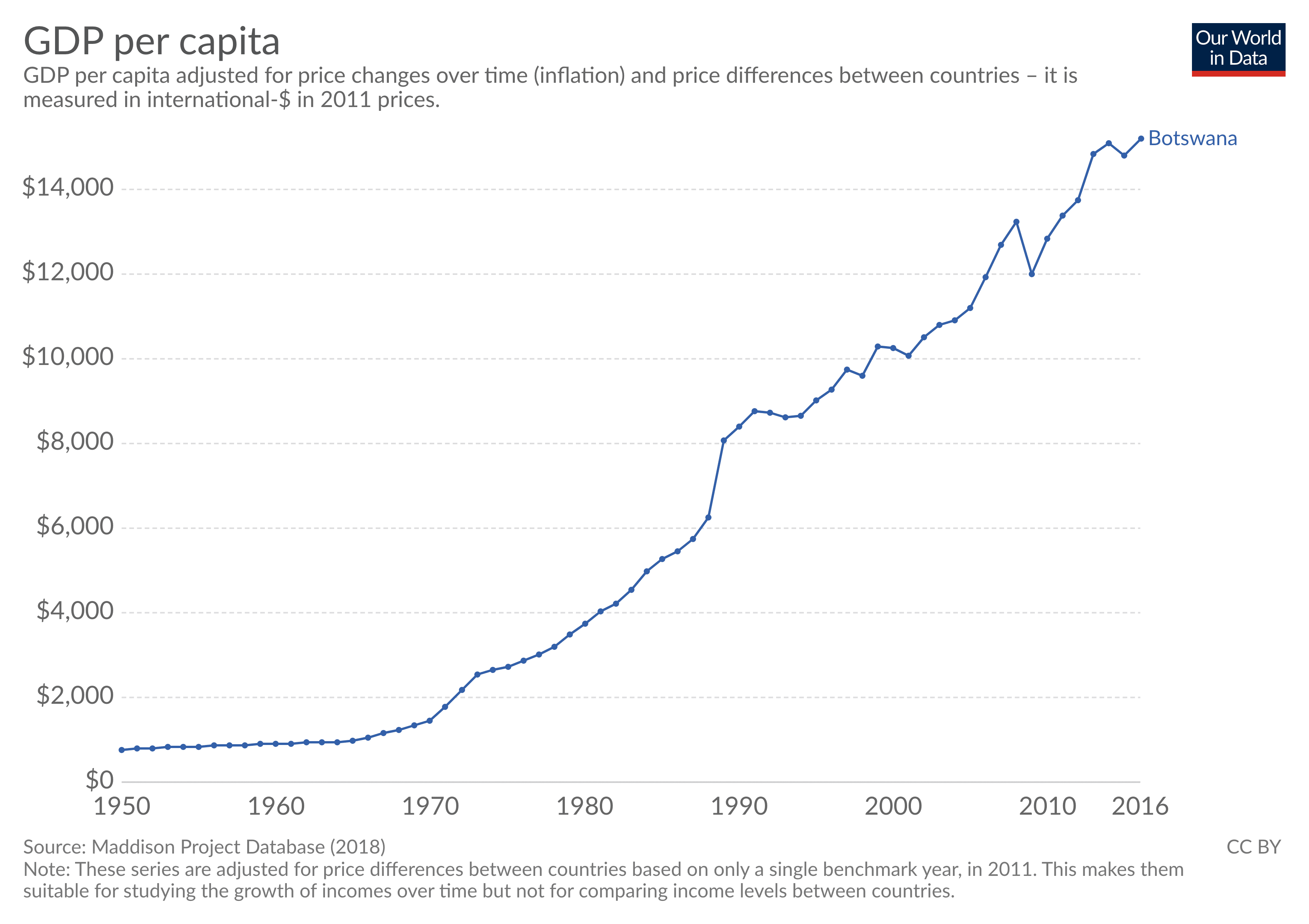
Botswana is the best economic success story in Africa. However, the achievement did not occur without significant assistance (much of it entirely self-serving) from societies close to Botswana. The type of growth observed in the chart above is not possible without importing methods and technologies from outside of civilization.
Botswana’s Advantages
The following are advantages that tend to be overlooked by those pointing to Botswana’s success. These advantages include the following.
Advantage #1: Close Proximity to South Africa
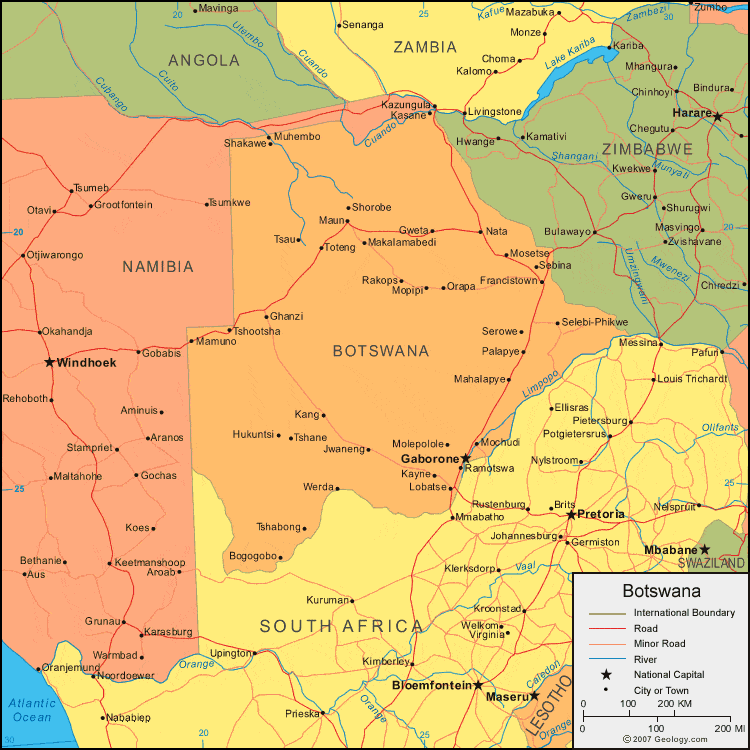
South Africa represents around 25% of all economic activity in South Africa. South Africa, as it is (or more was) a white-based society, and contained nearly all of the advanced items and advanced infrastructure in Africa. At one time, before the government transitioned to ANC control, they even had nuclear weapons (a program which was dismantled before the ANC took power.
Advantage #1: Proximity to White Run African Countries
South Africa’s capabilities give countries close to South Africa significant advantages. Not least among them is ready access to skilled labor, specifically engineering talent. South Africa has, for many years, had the world’s largest diamond mining operations, and De Beers has major operations in Botswana, which we will cover in more detail later in the article.
Botswana is also bordered by Namibia, which is another historically white-run country.
Therefore, two of Botswana’s largest neighbors are also two of the most advanced countries in Africa and both very experienced in mining, mining technology, and operations.
What About Angola
However, Angola also borders Namibia (but not South Africa), although its borders are south of Namibia, so it is less proximate to Namibia’s population. Angola has substantial mineral resources, much like Botswana. Still, the internal conflict and other reasons I am not privy to have prevented it from leveraging its position close to white-run countries (South Africa is no longer white-run, but I am speaking here of historical patterns).
This is explained in the following quotation.
Before independence in 1975, Angola was a breadbasket of southern Africa and a major exporter of bananas, coffee and sisal, but three decades of civil war (1975–2002) destroyed fertile countryside, left it littered with landmines and drove millions into the cities.
The country now depends on expensive food imports, mainly from South Africa and Portugal, while more than 90% of farming is done at the family and subsistence level. Thousands of Angolan small-scale farmers are trapped in poverty.[98] – Wikipedia
Advantage #2: A Small Population
Like Namibia, Botswana has a small population of only 2.3 M.
Why is this advantageous? Well, this leads to the next topic.
Advantage #3: Diamond Mining
Botswana has the world’s largest and most lucrative diamond mine.
Botswana leveraged its proximity to Western technical expertise, combined with its mineral endowment, to make diamonds a large percentage of its overall economy.
If Botswana’s population were, say, 25 million, that mineral wealth would not have such a strong promotional effect on the economy. That is where it would be less to “go around.”
In most African countries, such as Equatorial Guinea, the Democratic Republic of Congo, or Nigeria, the benefits of valuable natural resources go to a tiny elite. Botswana generally stopped this from happening. While the country still has high income inequality, many of the benefits of diamonds were shared.
The video pointed out that De Beers just wanted to buy raw diamonds from Botswana and then “add value” to them outside the country. Botswana pushed for more value-added work, such as converting diamonds into finished jewelry within the country. This is a constant issue with mining in Africa, that white-run companies really only want to export the raw materials from African nations, and add value outside of Africa.
Advantage #4: A Large Land Area Per its Population
Similarly, Botswana has an enviable land area, especially given its population. It has a landmass the size of France (population 66 M), but with only 3.4% of the population. This means that it would hypothetically face fewer environmental pressures (although, as we will see, Botswana does face environmental challenges). Other African countries have had their populations grow out of control. Botswana has avoided many of these problems.
Botswana’s Challenge of Desertification
However, even at this low population level, Botswana faces desertification, and its cattle industry, one of its largest industries, has overgrazed.
Botswana has large desert regions and little rain in most of the country. If it does not curtail its cattle industry, it could face serious consequences.
This will, of course, mean confronting Botswana’s cattle industry, which will naturally try to bribe politicians to ignore the long-term environmental consequences.
Desertification and water shortages are a worldwide issue. In the US western states, the Colorado River has been aggressively overconsumed. India’s groundwater levels are in severe decline.
The Coming Challenges
Botswana is predicted to run out of diamonds in just a few decades. This has led it—like many Middle Eastern countries —to try to use its current income from diamonds to diversify its economy. Most countries that try to do this are not successful.
Botswana has several technical labs it has set up as it tries to push into technology industries; however, the recent scandal around how it treated a mass death of elephants is not encouraging.
“This is a mass die-off on a level that hasn’t been seen in a very, very long time. Outside of drought, I don’t know of a die-off that has been this significant,” National Park Rescue’s McCann told The Guardian.
Botswana is home to around 130,000 elephants, Africa’s highest population of the animals, according to the BBC. However, numbers are in decline and the animals are classed as vulnerable, according to the World Wide Fund for Nature. Around 10,000 of those live in the grassy Okavango Delta, which floods seasonally.
At his election, President Masisi said he was putting the needs of the country’s population ahead of how western countries value the animals, The New York Times reported. The country auctioned off its first elephant hunting licenses in February 2020, the BBC reported.
On May 27, officials visited to take samples for testing, according to Hiley. As Botswana does not have its own testing capacity, they needed to be sent abroad.
Initially, the government said it would send them to a lab in Pretoria, South Africa, but instead sent them to a lab in northern Botswana, according to Hiley. Hiley described the lab as “unqualified” to handle them.
Conclusion
Botswana leveraged some of its advantages to do great things for its population. However, there is a problem in trying to generalize Botswana’s improvement to other African countries. Few African countries have the same advantages Botswana had, including its proximity to white-based countries, its low population, and its low population per resource and land area.
For example, let us say Tanzania wanted to copy Botswana. Tanzania also has large mineral endowments. However, it does not share a border with South Africa, and it has a population of 56 M. Tanzania has even more tourism than Botswana. Still, it does not have the same advantages as Botswana.
How Botswana Did It
Botswana exploited its resources with external technology and expertise. And they did a very good job of doing this. They could have ended up like Equatorial Guinea instead, but they have been managed far better. However, its two driving economic engines—its diamond resources and its cattle farming — have reached a point of diminishing returns. Their diamonds are running down, and their cattle industry has overgrazed the environment. Botswana will have to rely on other industries, as its two primary industries are in decline.
The problem Botswana faces is that few countries that have risen through resource extraction have successfully transitioned their economies to new areas. Botswana seeks to move into scientific laboratories. However, they could not even manage the distribution of samples from elephants who had died of mysterious causes. Developing a scientific culture in Africa, or in many countries with no experience in it, is no easy matter. Furthermore, there are no African nations outside of South Africa, when whites ran it, that have ever succeeded in areas outside of resource extraction and tourism. Can Botswana buck the trend?
Postscript
This article was written in July of 2020. Since this article was written, Botswana has gone downhill, which is covered in this article.
This is yet more evidence that black-run countries (and cities, for example, in the US) cannot be successful. Whenever blacks run anything, that area will never be competitive with countries, cities, or companies that are not run by blacks. This is a problem for liberals who constantly point to Botswana as an example of a well-run black country.