
The Long Term Implications of Big Tech’s Lack of Profitability
Executive Summary
- What does Big Tech’s long-term low profitability most likely mean for the area?
Introduction
A little-discussed issue is what the low profitability of Big Tech means for the future of Big Tech.
Big Tech and similar technology firms in the software space have tremendous power and sway. However, it is not because they are generally profitable businesses. Furthermore, a big part of technology influence has been the ability to raise money, with the promise that these firms would provide high returns in the future. This now looks increasingly unlikely to come to pass.
About Layoffs in the Technology Space in late 2022 and Early 2023
The following graphic is from Layoffs.fyi
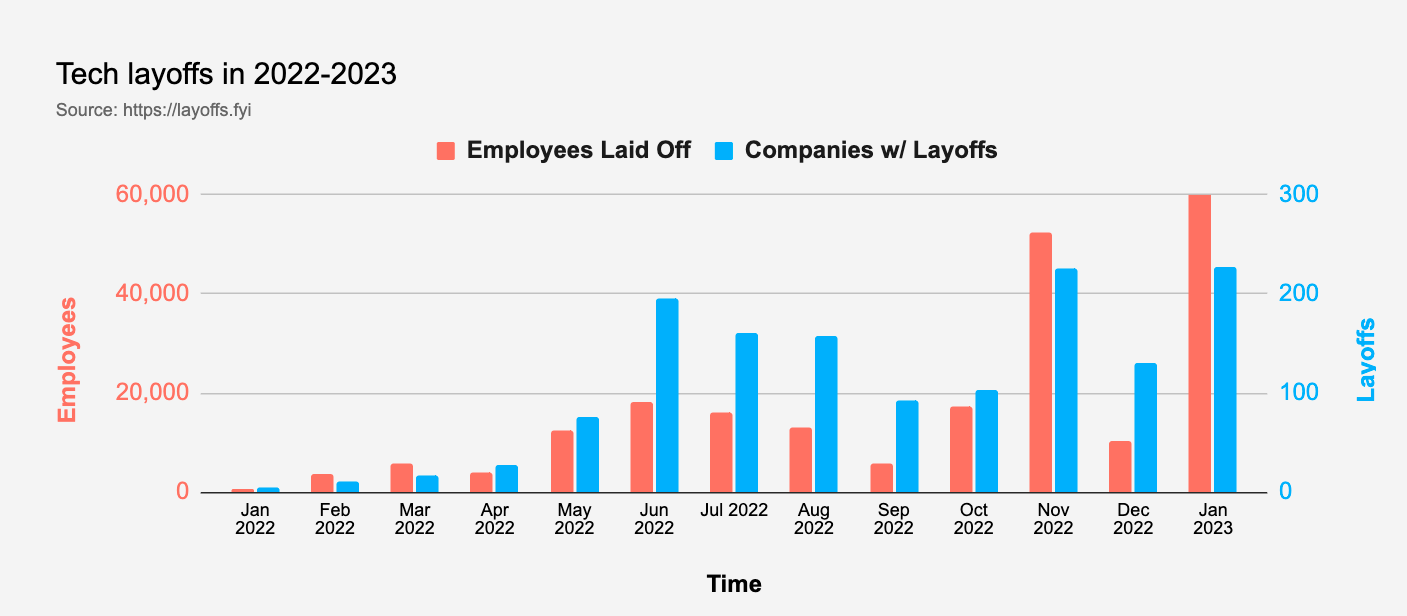
This is the layoffs tracker in the IT industry (only). Over several months, we can see a bloodbath in the IT industry. Since the beginning of the year, 50+K were laid off. With 10K & 12K, Microsoft and Google made up less than half. So, the year will be interesting.
- In 12 months of 2022, 1,040 tech companies laid off 159,684 employees, while only during the first month of 2023, 229 tech companies laid off 68,502 employees.
- This is about 42% of the first year, during the first month, and the month is not yet finished.
- These numbers come from open sources where companies explicitly disclose them. However, some prefer not to disclose this information, so we can only estimate the actual number.
The issue is that 99% of IT companies today cannot generate any profit and are heavily dependent on debt or venture capital influx.
Today more than 90% of IT companies are like Twitter, which has never made money yet has a massive valuation. Twitter’s business model has been entirely focused on advertising.
The Hidden Problem
The hidden problem, rarely highlighted, is that today we have a generation of people who have never worked for a profitable company. Just imagine hundreds of thousands of people who are 30-35 years old and have never worked for any non-startup company.
I have worked for startups twice, each time for less than half a year. You cannot even imagine how much company culture differs from businesses that can generate profit. I have never seen so many stupid and irrational decisions from managers and such a dramatic level of unprofessionalism. When you try to speak with such people and discuss the existing imbalance in the economics of endless monetary madness, they cannot understand the point. They think that venture capital will exist in parallel reality forever, and there will always be a new startup to find a new meaningless job… and the number of jobs will only grow.
What is Happening in Late 2022 and 2023 With Big Tech
After riding high for so many years, Big Tech has gone through significant layoffs. Big Tech valuations are now a substantial portion of the different stock market indices, and if you look at what the companies do and the value they add – they have far too many people working there. They have videos showing how pampered the employees at Twitter are. No one should control these platforms. Look at how simple these applications are; although they are not profitable, these companies extract far too much money for what they do. How many employees are necessary to maintain a site like Facebook or Twitter? How many of these jobs are simply fluff?
Many technology companies have a business model based on raising money rather than making money or ever being profitable. The natural idea is that this can only go on for so long.
These are questions I posed to Denis Myagkov on this and related topics.
Question #1
What does the future look like for money availability or funding for Big Tech? What would be the most likely projection of how it will change?
Answer
The first tier of investors in Tech are investment funds that can create a derivative portfolio of instruments by mixing high and low-risk assets (securities).
- The more prominent investors are BlackRock, Vanguard, and Fidelity.
- The second tier includes investment banks such as JP Morgan, Goldman Sachs, SoftBank, etc.
- The third tier is institutional investors, such as retirement funds and corporations. The last tier is private investors.
Over the last 15 years, the Fed, the ECB, the Bank of Japan, and central banks in other major economies printed money out of thin air, and companies in the first tier got “early access” to this liquidity.
The closer you are to the money printer, the more profitable it is for you, as you get money with lower inflation and lower discount factors.
In reality, inflation has an inhibiting effect; money first has to be distributed over the market, then “market agents” will reconsider prices, and so on.
This paradigm could work as long as central banks continue to print money. However, this year, we have witnessed the beginnings of a recession, not a recession, and inflation, which is (I don’t remember the actual term; something like a periodic, will update later).
Reason #1
In these circumstances, additional money printing will accelerate inflation with unpredictable outcomes. Therefore, the Federal Reserve and other central banks throttled the money printer and increased rates to slow down inflation and to try to engineer a soft landing designed to postpone a broader collapse in multiple asset bubbles built up during the covid pandemic.
Higher rates mean servicing debt becomes more expensive, and throttling the money printer implies less accessible liquidity, driving up demand for USD to meet existing obligations. So today, all tiers of investors need money to service their debts, not to invest in another promising social network.
That was the first reason.
Reason #2
- The second reason is that with lower rates, unprofitable companies could take a new loan to service the previous ones.
- It could work when rates are near zero or even lower.
So, the outcome of this money printing was that money/capital markets became less accessible to most businesses, and the IT industry was affected more, as 99% of companies cannot generate capital (unprofitable). In this way, most technology companies are subsidized and on permanent welfare – even though they look very successful.
You can easily confirm this by reading about motivations for layoffs in press releases. The most mentioned reasons are the market situation and the need to generate profit. However, why was this not an issue 12 months ago? Why has this only become an issue relatively recently, even though these tech companies have been unprofitable for many years?
If we look back into the past, each time the Fed reduced rates, the market reacted by propping up unprofitable businesses – but not everywhere, only really in the “trendy” areas of tech.
So, it is an open question – will the Fed take this risk to save Big Tech and other technology firms or let it die so that these companies shrink or go out of business entirely?
Question #2
Every bubble that breaks has a hangover effect. What is a likely projection of the hangover effect for technology?
Answer
When the bubble bursts, it will turn assets into liabilities on the balance sheets of investors of all levels.
Let’s say Blackrock created a risk-off investment product for retirement funds and corporations, which includes commodities, immovable, and Big Tech stocks, for instance, Snapchat, and sells them for $100 per unit. The retirement fund bought such products for 10 billion, as the declared risk level fits the threshold, and showed them on its balance sheet as 10.01 billion with the future discount factor.
If, or rather when, the market stops believing that SnapChat will provide an ROI on the 26 billion it got in the IPO, BlackRock and the retirement fund will need to multiply related assets by minus one.
- The amount of liquidity allocated to different kinds of tech companies will cause collapses (bankruptcies) in many investments and retirement funds.
- For most people, it means they will never see any retirement payments.
In 2021, the United States had 1,035 initial public offerings (IPOs). In 2022, however, the number of IPOs dropped to 181. So, we have reached the size of the bubble and are now only way down—about 80% less IPO in 2022.
Question #3
Big Tech firms used to have a positive image and were considered net positive societal contributors. Google is nearly always deified in media; however, what is Google’s real contribution? Now Google provides more corrupt search results than ever before, and the US DOJ has just filed a lawsuit against it for monopolizing advertising.
Twitter has been exposed as colluding with pharma companies and the US government to censor speech. All Big Tech platforms allow their databases to be fully open to the NSA/CIA, including international users, making them tools for US foreign policy. As their power has grown, they have shifted from being non-political to highly political and engaging in censorship, jumping onto the elite idea of “misinformation,” whose definition is whatever people at Davos don’t want the public to know.
The more time passes, the more unethical behavior by Big Tech gets exposed. However, as Big Tech colludes with Big Media, these stories are not covered in Big Media. However, I predict that there will be even more scandals.
What is the most likely projection of what this loss of trust in Big Tech means for these companies?
Answer
Google’s unofficial motto has long been “don’t be evil.” But that’s over, according to the code of conduct that Google distributes to its employees. The term was removed sometime in late April or early May of 2018.
My take on that positive image is no more than the efforts of the PR department. Looking back, we have more than ten years of narrative that we are on the verge of the Industrial Revolution 4.0. Still, comparing the number of people involved in tech today with the results achieved will look ridiculous.
In the 60s, people dreamed about exploring space, but today we have TikTok and Tesla autopilot.
There is a joke in ML/AI communities: instead of exploring space, the most brilliant guys on the planet have good algorithms that decide what ad to show you in the browser.
Conclusion
Any large tech company that you can name today is corrupt. They not only receive enormous amounts of money for what is really technology they developed a long time ago, but, through things like censorship and manipulation of users, it’s getting worse every year. Secondly, the technology space is becoming a parasite on the finances of the United States, with AI as a prime example of a business category that gobbles up investment money and offers very little in return.