
The Massive Problem of Google Search and The Need for Paid Search Engines
Executive Summary
- Google’s search is monopolistic, highly censored, politically biased, and controlled by the government and advertising money.
- In this article, I will discuss the reasons for stopping using Google and moving towards paid search.
Introduction
The Google algorithm does not have parameters that allow users to emphasize or deemphasize different types of sites. This is something that would be of great assistance to users, but which Google has never offered.
About My History Investigating Google Search
Over several years, I have been concerned about Google’s dominance in search and have written several articles about problems with Google’s (the holding company for Google is called Alphabet) business model and the search results I receive from Google. One example is an article titled Why Is There No Preference Adjustment in Google?
Recently, I investigated Google’s results. Google gets 98% of its revenue from advertising, and its results are increasingly censored and controlled by advertising. Because they dominate internet searches, governments also pressure them to censor results. Google clearly supports the DNC and adjusts its search results to help elect its preferred party. It also opens its servers to government surveillance entities like law enforcement, the FBI, and the NSA. As Google is deeply intertwined with the CIA and NSA (as is Facebook and other Big Tech platforms),, they do the same thing internationally. Not many people know that Google began using funding from US intelligence organizations in the first place — with these intelligence operations desiring a surveillance platform.
Google’s Corrupt Search Results
When you type a search query into Google, you get the top results connected to whoever is paying them the most money. They say they are providing the most relevant results, but testing by me and many others shows this can’t possibly be true. Furthermore, Google doesn’t disclose any of this, and many other search engines, while better than Google, often use some of Google’s search results. They are wholly corrupt and completely dominant in web search, influencing other search engines with their results. In testing Bing, which is Microsoft’s search engine, I found Google to be far more censored than Bing (that is, smaller non-status quotes and corrupt web sources were significantly suppressed by Google versus Bing). What is amazing about this is that Microsoft, along with Oracle, Facebook, and SAP, has always set the bottom of ethics in the tech industry. So, the fact that Google is far below what Satan on Earth is, in effect, in Microsoft, is quite a statement.
Google’s Corruption Has Grown Every Year They Have Been in Existence
Every year that Google has been in existence, it has become corrupt. Here is a perfect example. Most people reading this article will have a Gmail account. Think back to early Gmail. If you remember, Gmail made a name for itself by having an excellent spam filter. However, as the years passed, more spam “got through.”
How did Gmail’s spam filter switch from being the best out there to one of the worst? The answer is that Google wanted to monetize Gmail, so they adjusted their spam filter to allow much more spam through.
Now I don’t so much read my Gmail as “scan it” to see which of the many emails is something I am interested in reading. This is the same thing Google did with its search engine. Google used to have an excellent search engine. I first discovered them around 1998. However, to increasingly monetize the search engine, it is far better not to use Google.
The Lack of General Understanding of This Important Topic of Advertising Supported Search Versus Paid Search
I have had several conversations with librarians on this topic. They appeared clueless that their library has Google as the default search engine on all its computers. They did not understand the implications of Google’s advertising driving the search results. Several librarians zoned out on me during these conversations.
How Google Sells Users to Advertisers
The major problem is that Google makes around $300 by selling every user to advertisers—although very few companies in the world have so many users to monetize. Because users pay nothing, they have no ability to pressure Google to put users’ interests before advertisers’ interests, or the interests of governments that want Google to push their PR.
What Google is Versus What it Says It Is
Google is a wolf in sheep’s clothing. They are pretending to offer an innocuous information search to users to “help them.” However, in reality, it is a tool for surveillance (hence why most searches are performed on computers logged into Google services like Gmail, or where the user is logged into another site through Google within the same browser), censorship, and directing unsuspecting users to the most corrupt internet sources. Google receives around $270 billion a year from advertisers, but still presents the facade that it exists to serve users. Google lies about being a pure advertising company by saying the majority of its revenue comes from advertising, when in fact 98% of its revenue comes from advertising.
Google can lie to users and suppress non-status-quo websites because it averages around 90 to 95% market share, depending on the country. Meanwhile, they pretend they are not a monopoly—and pay off university professors to write papers saying Google is not a monopoly, as is covered in the quotes from the following article Google Exposed: New Evidence Reveals an Extreme Level of Manipulation, Corruption.
The Wall Street Journal took their research a bit further, and what they discovered is astounding. WSJ reported:
“Some researchers share their papers before publication and let Google give suggestions, according to thousands of pages of emails obtained by the Journal in public-records requests of more than a dozen university professors. The professors don’t always reveal Google’s backing in their research, and few disclosed the financial ties in subsequent articles on the same or similar topics, the Journal found.”
Google has paid anywhere between $5,000 and $40,000 per paper, and the number of studies surged the highest in 2012 when the company was being investigated by the Federal Trade Commission and European regulators for antitrust violations. At least 50 studies on antitrust issues authored between 2011 and 2013 were bought and paid for by Google.
And in the article, Google’s Dark History.
In all, 54 percent were authored by academics directly funded by Google, while the remainder worked for, or were affiliated with, groups or institutions funded by Google. In the majority of cases identified, readers were given no indication of the company’s interest in the paper — authors didn’t disclose Google funding in 65 percent of cases, even when the company directly paid for the study.
Moreover, the number of Google-funded studies published tended to spike when the company came under scrutiny from regulators, or when its competitors faced greater regulation.
For instance, starting in 2011, Google funded a deluge of academic studies antitrust issues, just when US antitrust regulators began examining the company. Over the next two years, Google-funded academics authored at least 50 papers on antitrust issues, all of which exonerated the search engine giant on charges of monopolization and uncompetitive practices to varying degrees.
One representative study, Google and the Limits of Antitrust: The Case Against the Case Against Google, authored by Geoffrey Manne, International Center for Law & Economics and Joshua Wright, George Mason University, concluded traditional conceptions of antitrust did not apply to the company, and an “aggressive” regulatory approach to Google could be “costly” in innovation terms.
The CfA noted Google-funded papers often blurred the line between academic research and paid advocacy by the company’s consultants — while some employed superficially legitimate research methodologies, many lacked even basic standards of academic rigor, with certain papers being little more than thinly-veiled promotional pieces, outlining the beliefs of an individual in the pay of Google with little or no supporting evidence.
Such lying via omission plagues the organization to its highest levels — in 2013, then-Google chief executive Eric Schmidt cited papers paid for by Google in written answers to Congress supporting his contention the company wasn’t a monopoly, without mentioning their funding source.
Getting Away from Google With Paid Search
I have experimented with several paid search engines and used to tout Neeva until it went out of business because no one was willing to pay for a search engine that represents users’ interests. Recently, I found another paid search engine that isn’t as good as Neeva was, but it’s still a very good option. This is called Kagi. I thought you might not know how Google manipulates your search results, so I would suggest it to anyone interested in far better, less financially biased, and less censored search.
Experience With Kagi
As I write this, I have been using Kagi for a week and a half, and I find searching much more fulfilling and easier now than it was with even less corrupt search engines than Google, like Ghostery or DuckDuckGo.
The Cost of Kagi
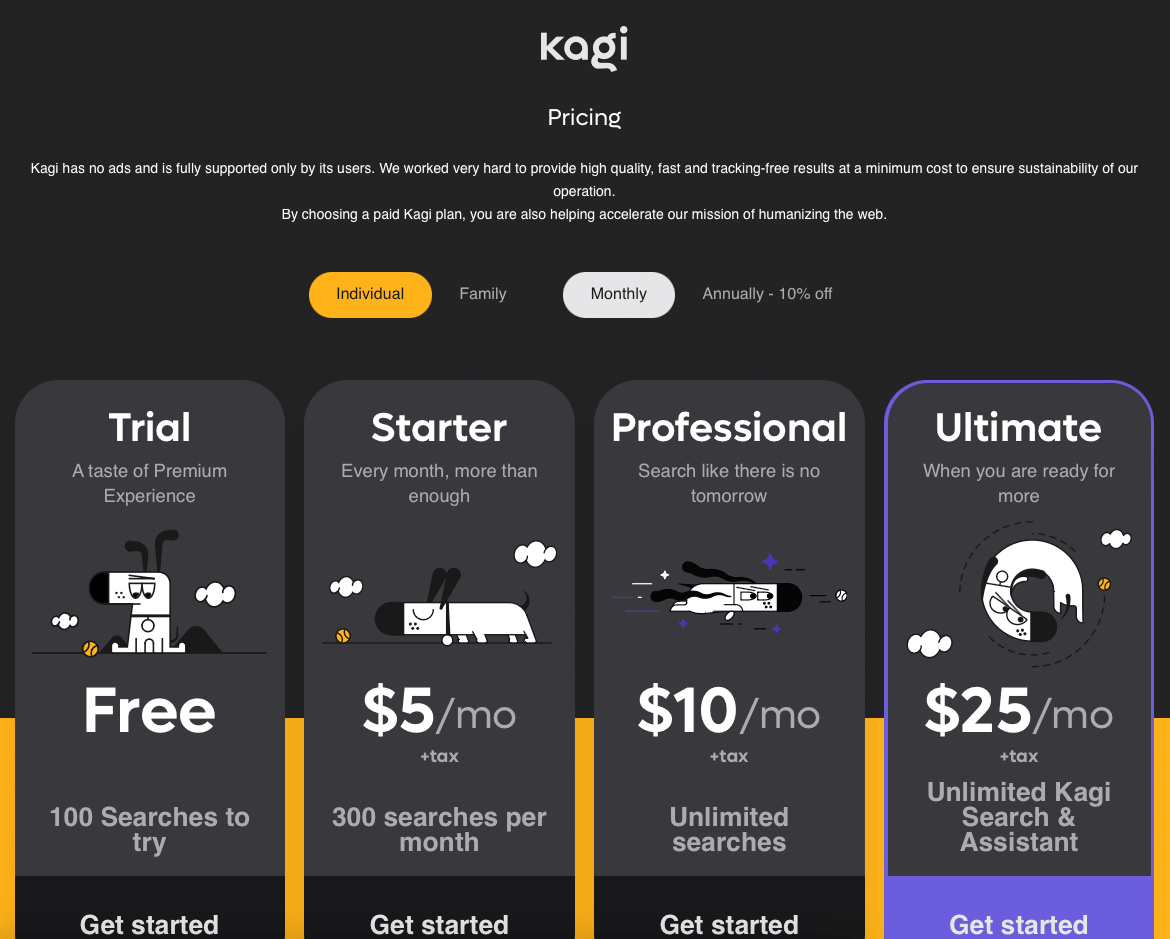
Here is Kagi’s pricing.
The Cost Benefit of Kagi
It is easily worth the monthly or yearly cost.
For a year of getting advertizing-free searches with the ability to promote or demote search sources, in addition to other features, Kagi search is probably the best value of any purchase I will make during this year. The search engine and browser are among the most important things anyone uses daily.
My Lack of Interaction With or Financial Bias in Favor of Kagi
I have never contacted Kagi, and Kagi has not paid me to write this article. It is the opposite: I pay Kagi to use both their search engine and their browser — which is another topic. Everything I know about Kagi comes from reading their website and using their search engine and browser, Orion, not from any interaction with Kagi.
I can think of ways that Kagi can be better. I would like to set search parameters more broadly than just blocking, deemphasizing, or emphasizing sources. Sources can be categorized by different criteria, and those criteria can then be set as adjustable parameters. This is the approach that Neeva used, and it was very powerful. You set it once, and then just use the search engine after that.
However, I do have to say that Kagi—well, better than Google—is still highly censored. And if I want to find answers to non-politically correct questions, I have to go to Yandex.
About The Orion Browser
Orion has extremely efficient memory management, and I have migrated a number of my tabs from Ghostery (a great browser but far more memory-intensive) to Orion. I am currently running two versions of Orion, Orion and Orion +, and I am very impressed with the browser. So, finding Kagi has been a big win for me, as I was exposed not only to their search engine but also to their browser. This combination has improved my research and computer usage.
My View on The Importance of Paid Search
I think paid search is an important topic that I am happy to evangelize for paid search and Kagi anytime. I would promote other paid search options (as I said, I was a big advocate for Neeva before they shut their search engine down — and I lost a great deal of research productivity when Neeva shut down), but there aren’t many paid search offerings I can name, as the percentage of people who will pay for a search engine is small.
Also Using Yandex
Another search engine I tested and found to be very good was Yandex, a Russian company. Yandex is not paid search, but its results are, in cases where the topic is hotly contested, significantly better than Kagi’s. See these results from Kagi for the search “vaccination.”

The first search result (actually multiple results) from Kagi is the CDC. The CDC is a highly corrupt entity infested with undisclosed pharmaceutical interests and has repeatedly been caught hiding and rigging data. Its objective is to promote fear of pandemics and vaccines, as it is essentially a marketing front for the vaccine industry. The CDC has many credentialed people working there; however, it is another example that credentials and knowledge cannot make up for financial conflicts.
I don’t consider the CDC to be a reliable source of information.
Their second result is the WHO.
The WHO is yet another highly corrupt health entity whose second-largest funder is the Bill & Melinda Gates Foundation. I don’t care what Bill Gates has to say on any topic, nor what the WHO says on any topic, and unless I am writing an article about medical corruption, I don’t want to see them in my search results. However, I could block these sources from future search results. I went on to block the following sources.
- Johns Hopkins
- The FDA
- Heathline
- NPR
- The Cleveland Clinic
- The NHS
- Vaccines.gov
- The Mayo Clinic
Now I won’t see their sites in any future search results in Kagi.
What Sites Provide Customizability of the Search Results
Notice that this ability to adjust the search results does not exist in any of the search engines that are not paid search. It appears that if you want adjustability, only paid search will offer it. Neeva had the best parameter adjustment to search results I have ever seen. For example, I was able to de-emphasize commercial results in search results. There were other parameters I changed as well, making the search engine customized for my interests.
Searching in Yandex

Yandex also lists the WHO very high up in its results, but some sources also question vaccines. Yandex’s search results are far less hierarchical than those from Kagi and allow for different views.
Yandex is based in Russia, a country with very restricted freedom of speech. However, Yandex’s search engine allows more freedom of speech and more views that oppose the official view than any of the search engines I tested that are based in the US. This illustrates that the US dedication to freedom of speech is wavering, and this is what also happens when corporations infest any platform. Microsoft or Pfizer have no interest in freedom of speech – they certainly don’t want you to hear the speech of their competitors or their critics.
When Totalitarian Systems Present Themselves as the Consensus
The government and the politically correct believe there is only one view, and everyone must adhere to this single view. This is a totalitarian view that masquerades as being the “official view.” However, Orwell’s 1984 often presents something as consensus, but it’s only consensus because other views have been censored or suppressed. In many circles, anyone who disagrees with the orthodoxy is called a conspiracy theorist or “far right-wing” racist, sexist, etc.
Censorship in the US
Here, we have examples of multiple politicians contradicting the First Amendment. Even in the country with the strongest freedom-of-speech laws ever created, there is still an unending attempt to restrict speech. The current line is that, to defend democracy, we need to shrink freedom of speech. Once speech is sufficiently restricted, then we will have a perfect democracy.
Internet Censorship in Brazil
Brazil has censored X/Twitter in Brazil. This prevents Brazilians from accessing this website unless they use a VPN; however, Brazil has made it illegal to access X/Twitter via a VPN. Try to wrap your head around that. This is explained in the following quotation from the article Brazil X Ban VPN Legal Tech Implications.
Moraes ruled that using “technological subterfuges” to bypass the blocking of X is prohibited, making VPN-enabled access to X in Brazil punishable by a fine of 50,000 Brazilian reais ($8,900) per day.
This is a shocking amount in a country where the average pay is far less than that in a year.
Some VPN operators agree that tracing Brazilians who access X via VPNs would be a challenge for local enforcement.
“At the moment, it seems difficult to imagine how the Brazilian government’s proposed fines on people using VPNs to access X could be implemented from a technical standpoint,” a spokesperson from the VPN provider Surfshark told Cointelegraph.
Short Discussion on The Opposing Sides of Censorship
This is an excellent display of the two opposing sides on the nature of censorship. The term “hate speech” has been created to categorize whatever the opponent of that speech wants to be censored.
The Censorship Playbook
Those who disagree with the orthodoxy are hit with personal attacks. This is the same behind blasphemy laws. I am the proud recipient of a letter from the Government of Pakistan that stated an article I wrote on Islam “offended all of Pakistan and their cherished belief in Islam.” I think the idea of the letter was that I would fly to Pakistan to go through their court system.
The problem?
I did blaspheme against Islam, and the second problem is that in Pakistan, the penalty for blasphemy is death. Islam has historically never allowed its ideas to be questioned and threatens those who do so with death. This is a primary reason Islam has succeeded in spreading itself. The Government of Pakistan has a lot in common with search engines that believe they have the right to dictate what you think and control what you see and read.
The mind controllers, along with those who work in marketing or PR departments, believe in supporting the party line and also support covering up contradictions or inconsistencies in the favored hypothesis instead of exposing and discussing them. Being more educated does not appear to mitigate this behavioral pattern, as some of the most educated people also favor this single-view philosophy.
I like Yandex’s results on controversial topics, but Kagi is a much slicker product. And easier to use and to read. However, I still plan to use Yandex occasionally to see their results. I would prefer that any search engine I use is paid, and I would like it if Yandex offered a paid search option. The reason is that I want to be the one paying, because I want to be the customer of the search engine rather than the sources listed by the search engine being the customer.
Conclusion
This is one of the big problems of our time. Media and search engines offer their service free of charge only to be funded by to large corrupt companies without telling the reader or user. In addition to its corrupt search engine and business model, Google has done enormous damage to the media by pulling advertising from it (still a problem, but concentrating advertising at Google has only made it worse). Google tops it all off by saying it supports media, when in fact it has hollowed out media. Google has its targets on all sites, not just media sites, with its synopsis “AI.” Google now creates synopses of websites with “AI” to deny sites the traffic they used to get. Google’s “AI” is a form of legitimized plagiarism. They say they are “training” their “AI” on data — however, this is plagiarism. If the software does it — it is not called plagiarism. No one could have anticipated how evil Google would eventually become.
Google’s entire relationship with its search users is based on a lie—which I have discussed already —and Google’s relationship with websites is also based on a lie. Google started out saying they were just going to direct users to sources that were relevant to them. They decried that Yahoo directed users to Yahoo content at the time. However, now Google is stealing websites’ IP and presenting it as its own. So they have radically changed the arrangement and agreement with websites.