Was Leonardo Da Vinci Actually Inspired by Al Jazari?
Executive Summary
- Muslims have created yet another story of how some intellectual achievement is actually based upon the previous work of a Muslim.
- In this article, we review the claims that Leonardo Da Vinci was inspired by Al Jazari.

Introduction
This video claims both that Leonardo Da Vinci was inspired by Al-Jazari and that he took credit for Al-Jazari’s work.
Video on Al Jazari as Leonardo Da Vinci’s Inspiration
I just checked Wikipedia on this — “According to Encyclopædia Britannica, the Italian Renaissance inventor Leonardo da Vinci may have been influenced by the classic automata of al-Jazari.”
Basically, this is a hypothesis promoted exclusively by Muslims. I cannot find any evidence that da Vinci knew who Al Jazari was, was aware of his work, or was inspired by it. I can also propose that da Vinci may have been inspired by Hinduism, and anyone can propose that da Vinci “may have been inspired” by anything that came before da Vinci. However, there is supposed to be a standard for making claims: some evidence must exist that he was inspired by it to propose it as a fact. The maker of this video has no idea if Al-Jazari was the inspiration for da Vince or if a single drawing by da Vinci would be different if Al-Jazari had never existed. This video presents the case that not only was da Vinci inspired by Al Jazari, but also that da Vinci took credit for Al Jazari’s work. All of this is based upon “maybe da Vinci was inspired by Al Jazari.”
Reviewing the Potential Inspiration of Da Vinci by Analyzing Al Jazari’s Designs
I reviewed a number of Al Jazari’s designs myself. What I found was that Al Jazari’s designs are not as impressive as is desired in the video. They are instead very simplified drawings compared to what da Vinci created. Here are some examples of Al Jazari’s work.
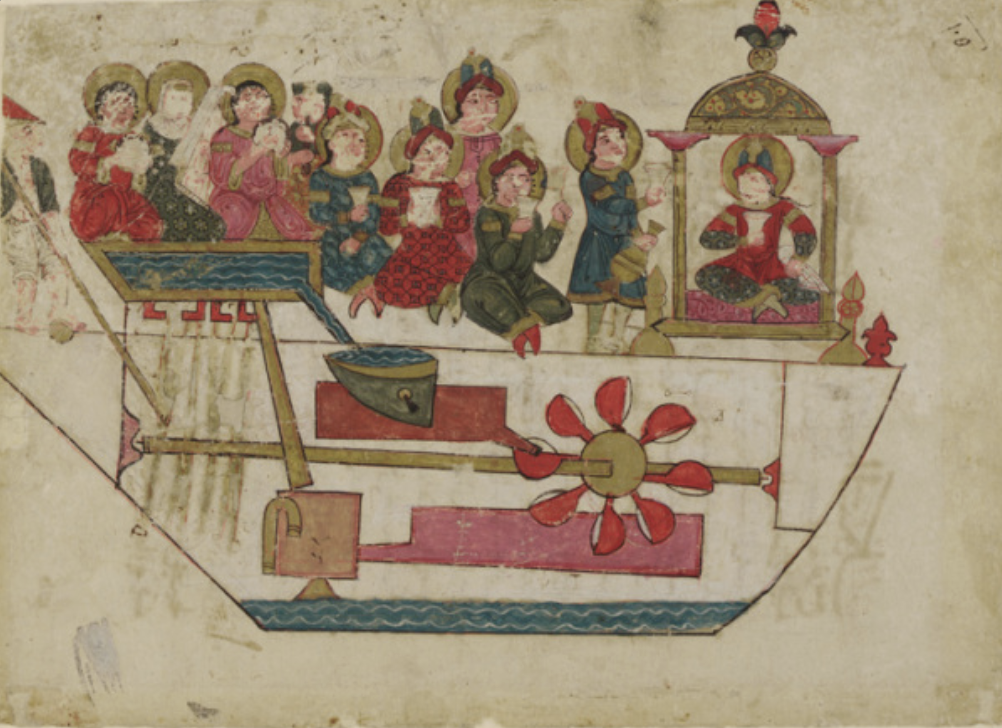
This ship looks more like a cartoon than a technical drawing.
Step 1?
Let’s see here. Water is flowing into a containment that is residing in a box. I think the water flows into cups positioned in a rotating pattern. I suppose this must turn the shaft — but where is the propeller? If there is no propeller, what is the point of turning the shaft?
Step 2?
It then drops off water into a catchment that flows outside of the boat?
That must be outside of the boat, but where is the lake or ocean line?
I also cannot tell what the brown streaks flowing below the initial water container are. Is that supposed to be heated water?
This image is another riddle. With Al Jazari’s illustrations, a level of frustration arises as one tries to figure out what he is saying and how the mechanism could work. I can’t even imagine creating a technical design drawing with this level of sloppiness.
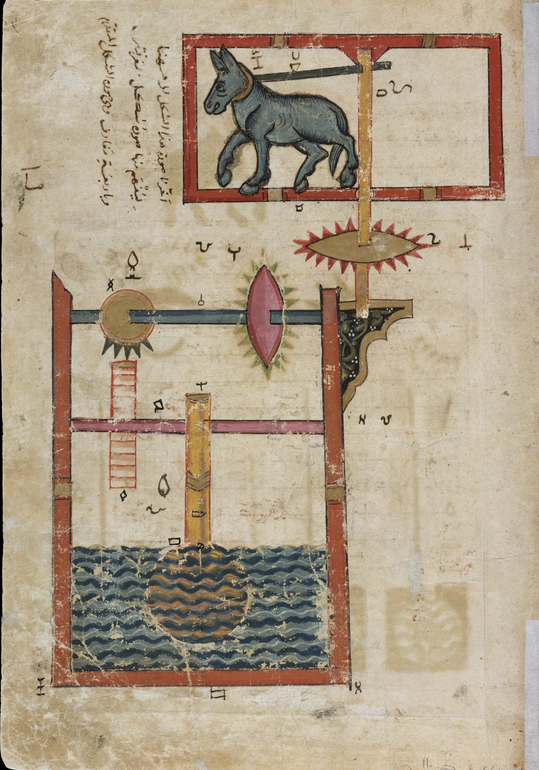
This design is also very difficult to discern what it is doing. It’s clearly some type of horse or donkey-based pump, but I don’t think it’s at all clear how to build this from the graphic. There is no way to translate the graphic into a working model. This illustration is kind of horrible. This is a very basic mechanism, one of the most basic, and Al Jazari struggles to really make even such a simple mechanism understandable.
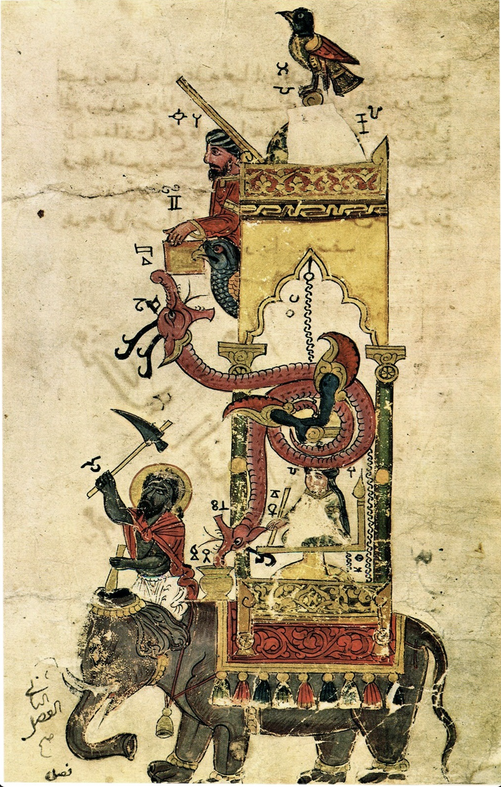
This design includes a form of dragon integral to the device’s operation.
A dragon is not going to be helpful in making something work, as they don’t exist.
One of the dragons appears to be drinking from a vase. The top dragon head appears to be about to chomp down on a book. So this is a design to allow a two-headed dragon to rotate atop an elephant, ensuring the dragon can both stay hydrated and bite a book? Is there really a major need for this type of thing? Or is this not a technical drawing at all, and just something Al Jazari found amusing to draw?
It’s very difficult to take the proponents of the hypothesis that Da Vinci was inspired by this seriously. What does any of this have to do with Da Vinci’s work?
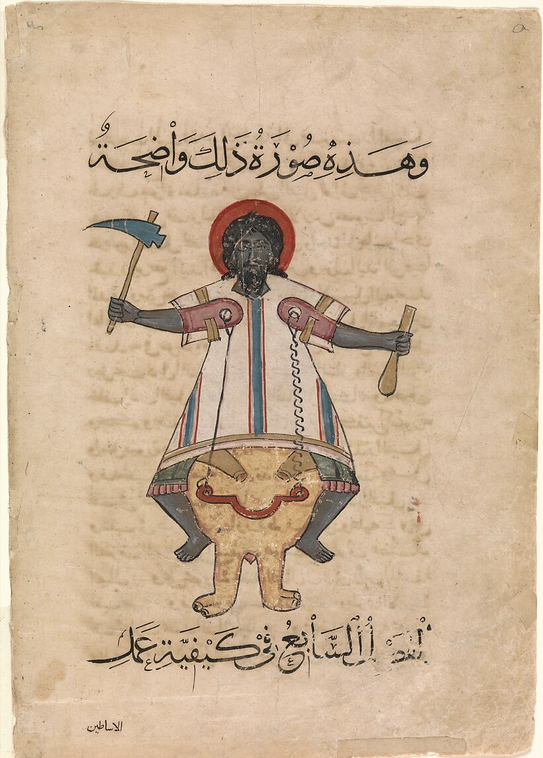
This design is bizarre, and rather than feeling like I am looking at a technical design, it feels more like a riddle I am being asked to solve.
This seems to be a warrior sitting on a very oddly shaped two-legged animal, with the animal’s head covered or underneath his clothing. The animal’s toes sort of look like a camel’s toes. That would make sense given it’s the Middle East. However, if this is a camel, where are the back legs, and where is the head?
If we leave out the accuracy of the camel’s depiction for a moment, we can see a rope of some kind that stretches from epaulets on the warrior’s shoulders around the animal’s neck. This seems to be a way to have a warrior strapped to his camel. Al Jazari’s illustration capabilities were so poor that he just gave up on drawing the camel’s head, neck, and shoulders. The fact that the warrior’s arms are outstretched, I think, signifies that the warrior can ride without holding onto reins. This is, of course, before they would have been aware of the saddle or stirrups.
Comparing Al Jarazi’s Artistic Skills Versus Da Vinci’s
Something never mentioned in the video, but which is quite apparent from reviewing all of Al Jazari’s work, is that Al Jazari was not a particularly talented artist. This will most likely make a few people angry, but I don’t see anything here in Al Jazari’s illustrations that I can’t do myself. Obviously, I have a lot of advantages in terms of supplies, paper, etc. However, I can’t replicate any of Da Vinci’s work with modern tools. The thing about matching up with Al Jazari is that nothing has to actually work. All the illustrator has to do is sort of put some items relatively close to each other. How any of the elements connect to each other is left out of most of Al Jazari’s illustrations.
I did not read Al Jazari’s notes, but from the drawings, it is difficult to see how any of the items I reviewed could actually work. With da Vinci, I don’t have the same problem figuring out the purpose from the drawing by itself.
Let’s look at a few of da Vinci’s designs.
Da Vinci’s Designs
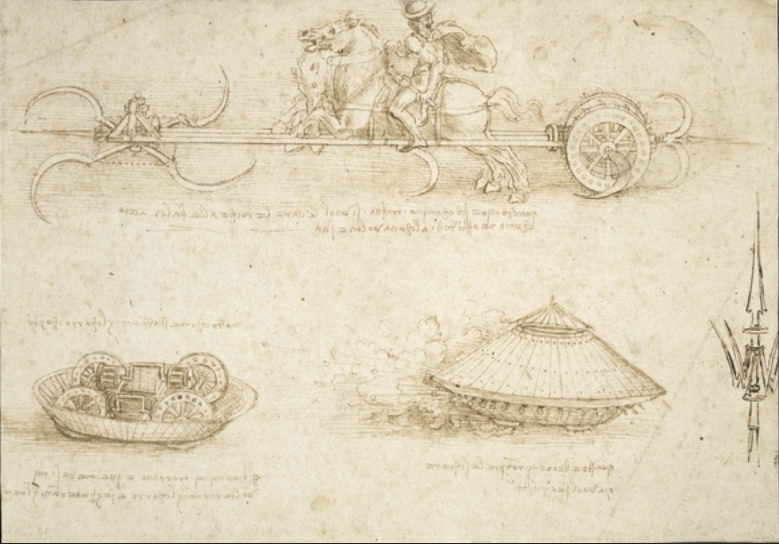
This is an illustration of a tank design. It may have been the first of its kind. As there were no engines at the time to put in the tank, this design was not practical. You would need some type of draft animal inside the tank. Tanks did not appear until hundreds of years later. However, unlike with Al Jazari’s work, I can tell what Da Vinci intends to occur with his drawings. As with Al Jazari, I did not read any of Da Vinci’s notes that accompanied the illustrations, but I can understand the basics.
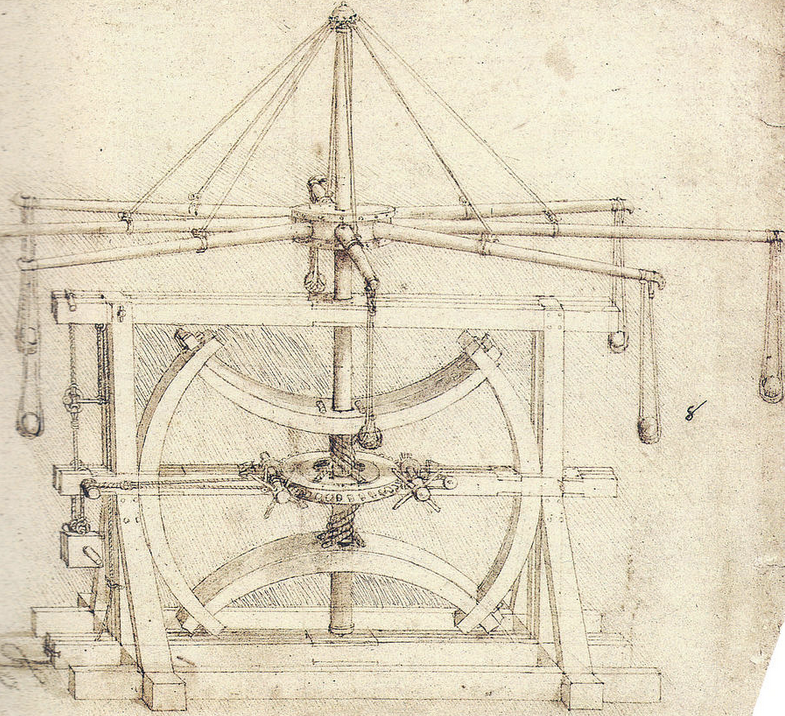 This is a design for a flying machine. Again, without an engine, there is no way to make this work. However, again, I can understand the machine’s motion just by looking at the image.
Da Vinci’s Illustrations of Human and Animal Bodies
Da Vinci drew a large number of designs that Al Jazari did not create, so the vast majority of da Vinci’s designs could not have been inspired by Al Jazari. Anyone proposing this has a very limited understanding of da Vinci’s work and why it was so groundbreaking, or is just proposing this to support a preconceived preferred outcome.
Regarding the type of work, Da Vinci dissected bodies and created some of the most detailed illustrations of the inside of human and animal bodies, including a fetus. Maybe someone else did this, too, but da Vinci is usually credited as the first. Here is an illustration of a dissected body.
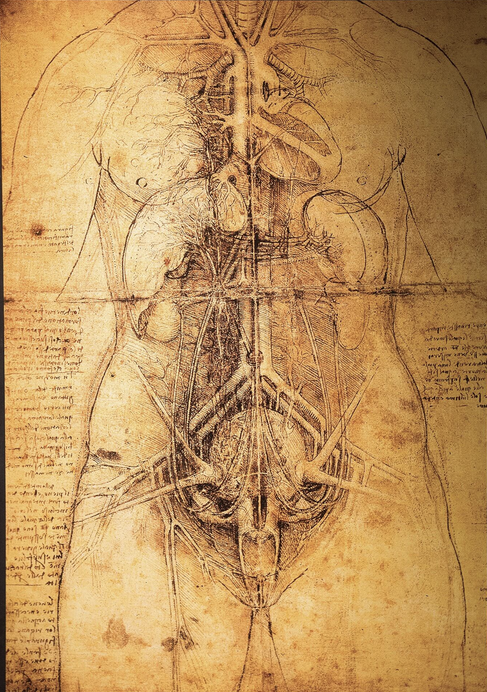
Look at that accuracy and detail.
I can’t find anything like this in any of Al Jazari’s work, and even if he had a dissected cadaver in front of him, he lacked the illustration skills to show anything like this level of detail. So my question for the promoters of this “Al Jazari inspiration” hypothesis is whether da Vinci was also inspired by work that Al Jazari never performed?
Da Vinci’s Photographic Level of Detail
Da Vinci’s illustrations have a level of detail that looks almost photographic. Al Jazari’s illustrations are closer to cartoons. If you notice, when Al Jazari has a gear or paddles, they don’t connect to anything. It’s more like he is just putting things close together without explaining the articulation.
Machines Not Seen for 800 Years After Al Jazari?
The video states that the machines that Al Jazari designed would not be seen for another 800 years. That is a ludicrous claim. Many Europeans created far more sophisticated designs before and after Al Jazari’s time. I imagine others in Asia probably did too, but I have not checked every region. The video being discussed uses modern graphics to make the drawings look far more impressive than they are on their own.
Claims at the End of the Video
Claim #1: Scientists and Engineers are Shocked at Al Jazari’s Work?
At the 11:00 mark in the video, it states the following:
In the 20th century, historians and engineers began studying Al Jazeri’s work again, and they were shocked. This was not just advanced for 1206, some of it is impressive even by today’s standards, his story is now being told. Museums around the world now feature his inventions. Universities now teach his work, and young engineers from the Middle East and beyond can look at it and feel proud, because genius is not limited to one place, one time, or one culture.
That is a massive exaggeration, and Al Jazari’s designs/illustrations weren’t very impressive even back in 1206. Looking through other illustrators/designers in Europe at that time, it would be easy to find similarly talented men. It seems the only reason this claim is made is to allow Muslims to claim they had someone of similar talent to Da Vinci. However, they chose a poor candidate, as the claim does not hold up to an analysis of Al Jazari’s work.
Claim #2: Modern Humans Owe a Great Debt to Al Jazari?
Every time a robot builds a car, every time an automated system saves a life in surgery, every time a machine explores another planet, we are using principles that Al Jazari pioneered 800 years ago.
If one is actually an engineer, or more specifically, a builder who intends to make any item in Al Jazari’s collection — the person would immediately note how little guidance there is to go about building any of Al Jazari’s designs. None of the items mentioned owes anything to Al Jazari’s designs. Al Jazari did not inspire any of these things, and it is a testament to the poor quality of Muslim illustrators that the Muslim interest group that produced this video could not find any more talented Muslim illustrator for whom to hang their hat.
Claim #3: Al Jazari Was a Genius and Built Robots Before Tesla?
Al Jazari the genius who built robots 800 years before Tesla. Al Jazari, the father of robotics, the master of automation, and the man who proved that genius knows no borders.
Al Jazari was not only not a genius but also not even close to being one, and he was a very mediocre illustrator. He also did not have much understanding of mechanisms, and, with respect to his illustrations of things like gears and water wheels, lacked the ability to coherently depict them in a way that would have enabled any of the items he designed to be built.
Al Jazari did not build anything, much less a robot. Tesla does not have a very good robot, but Al Jazari never even illustrated anything like a robot, so how can the claim be made that he built them in 1206?
This is an industrial robotic arm. How does this have anything to do with Al Jazari’s illustrations?
How would Al Jazari have had any idea that computers would be developed that would eventually serve as a sort of brain for robots? This overall assertion of the criticality of Al Jazari’s contributions to any of these later developed items is a complete nonsense claim, which apparently the Muslim group that created this video thought would sound good.
Curiously, while Al Jazari’s contributions were apparently central to all these later technologies, not a single one of them was developed in a Muslim country. With an 800-year head start, one would think at least one of them would have.
More Claims about Al Jazari by Muslims
These quotes are from the article Al Jazari, Leonardo Da Vinci, and the emergence of automation.
We have all heard of Leonardo Da Vinci (1452 – 1519) the great Italian inventor, painter and scientist. That is the way it should be; there is no doubting his unparalleled genius. But how many of us know that the person, who can rightly be called the father of automation predated Da Vinci by two hundred years, and was a Muslim? Ismail Al-Jazari (1136 – 1237), a mechanical engineer and scientist, laid the foundations of automation and robotics through his prodigious inventions.
In fact, it is more chronologically correct to call Da Vinci the Al-Jazari of Europe.
No, it is not, because Al Jazari did not make anywhere near the contributions of Da Vinci. They just happened to both be illustrators who created mechanical drawings. Not all people who create mechanical drawings can be called the Da Vinci of this or that.
Today, we worry about robots taking our jobs, and automation has definitely undermined the need for manual workers in many industries. Anxieties about automation go back centuries, and indeed, Al Jazali invented machines that were not just playthings for the rich, but devices with practical applications.
I can’t find anything that Al-Jazali created that was ever built. Nothing can be built from Al Jazari’s drawings without major modification. Of course, many items that Da Vinci designed were never built but inspired later ones. In the case of Da Vinci’s tank or “fighting machine” and flying designs, no engine existed at the time to make those designs workable.
In our time, if there is one nonwhite culture that is demonised and vilified, it is the Islamic world.
And for good reason.
Maligned by harmful stereotypes of bearded fanatics waving guns, the Muslim communities in the West are targeted as an ‘enemy within.’
It’s hard to argue that Muslims are not the enemy within. Muslims themselves declare they plan to takeover white originated countries and make all kaffirs submit to Islam.
This rampant Islamophobia, heavily promoted by a corporate media owned by a financial oligarchy, blinds us to the incredible innovations, both scientific and philosophical, of the Islamic civilisation.
Rampant Islamophobia is not promoted by corporate media — if anything its the opposite. CNN and other establishment media cover up Islamic terrorism and Islamic crimes like honor killings and Islamic rape gangs, and in the UK, those who critique Islam are often arrested and charged with hate crimes.
Also, none of this blinds me to the innovations of Islamic civilization. The bigger problem is that Muslims are constantly making false claims about Islamic innovation. I cover how the “Islamic Golden Age” is a massively exaggerated proposal of Islamic contributions to science and civilization that has been primarily paid for by oil-wealthy Muslim countries as a form of PR, and there are now numerous books designed to present Islam in a politically correct but inaccurate light — including the proposal that Islam was the world’s first feminist religion.
It is true that Jazari built upon the inventions of his predecessors. He was familiar with engineering techniques in China, Persia and so on. But it was his unique mindset and toolkit that made possible innovations which had a lasting impact. He documented his extensive efforts in a book of knowledge that has survived and been translated down the ages.
You see, that is a major part of the inaccuracy in the Islamic presentation of their place in the world and their scientific and related contributions. When Muslims take something from another group, they tend not to emphasize that fact. For example, Muslims took alchemy from other cultures. As with other cultures, they never made much progress with it, as alchemy focuses on chemical interactions, when the only way to produce actual alchemy is to engage in nuclear fusion (combining lighter elements into heavier elements like gold). This is impractical. However, when Muslims then claim that their work inspired chemistry, there is first an exaggeration of this contribution, but also the Muslims then tend to minimize the fact that they did not originate alchemy, and alchemy was being practiced in many parts of the world at the same time — however chemistry did not originate in the Muslim world, but instead first rose in nearly entirely in Europe.
Who Were the Pioneers of Chemistry?
Pioneers in the area included Jan Baptist van Helmont (a Dutchman) and Robert Boyle (an English/Irishman). Robert Boyle is credited with separating chemistry from alchemy. (see this source) Robert Boyle did not need to go to the Muslim world to do this, as alchemy was being actively pursued in Europe at that time. I cover this topic in the article Was Jabir Ibn Hayyan The Founder of Modern Chemistry?
Conclusion
This video is doing what it accuses da Vinci of doing: taking credit for da Vinci’s work and giving it to Al Jazari purely on the basis that the author is a Muslim and would like it to be true. All of this is consistent with the false claims about discoveries in the Golden Age of Islam, which I cover in the article “How Accurate is the Standard Presentation of the Islamic Golden Age?“